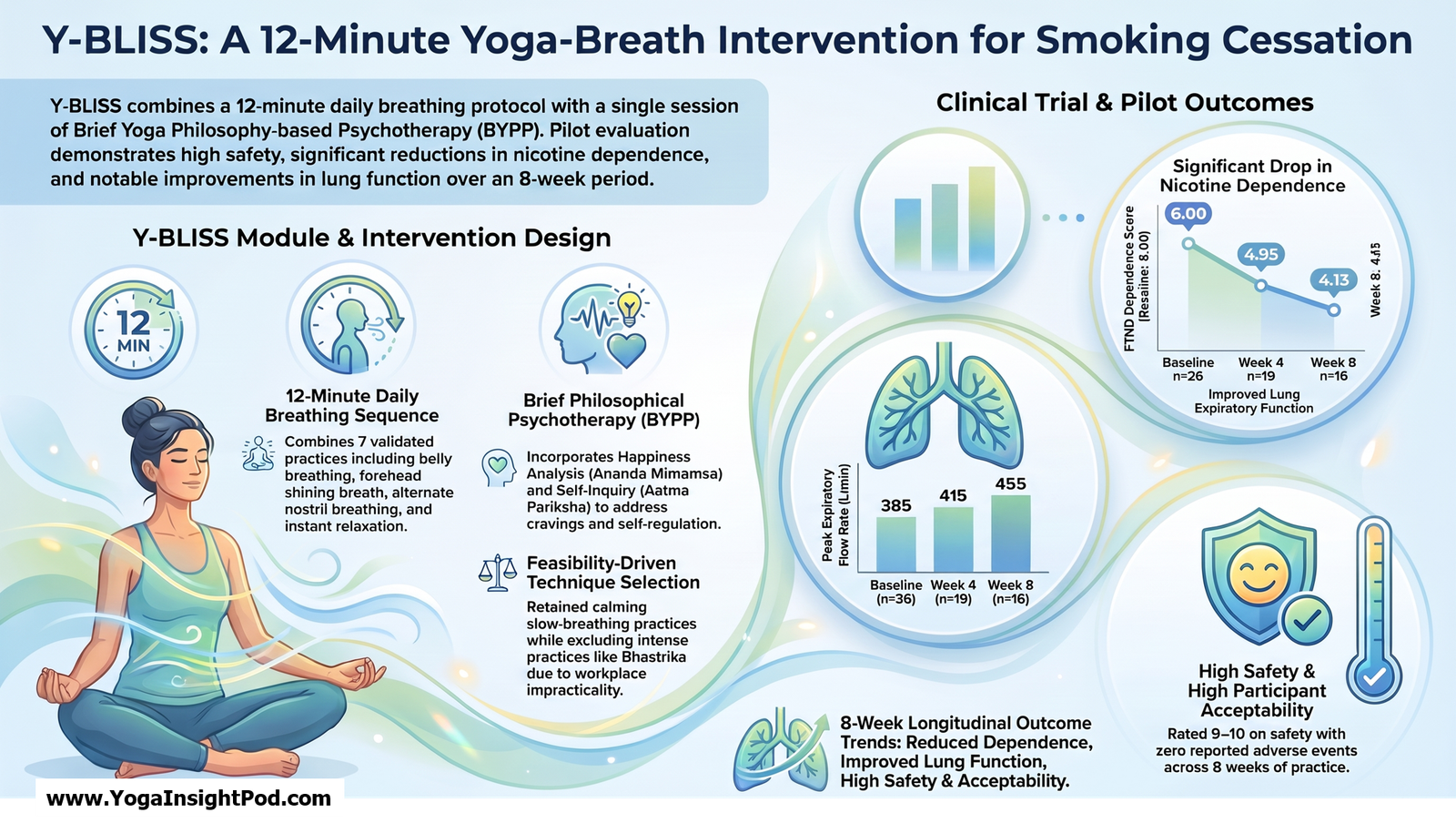
Can just 12 minutes of pranayama help reduce nicotine dependence and support smoking cessation? Explore findings from a feasibility study by M. V. Chandra Shekar, Hemant Bhargav, and colleagues from Swami Vivekananda Yoga Anusandhana Samsthana, the National Institute of Mental Health and Neurosciences (NIMHANS), Bharathi Institute, M.S. Ramaiah University of Applied Sciences, the Schizophrenia Research Foundation, and Harvard Medical School, examining the potential benefits of alternate nostril breathing, Kapalabhati, relaxation, and mindful breathing.
Can Yoga Breathing Support Smoking Cessation?
Can a brief daily yoga breathing routine help individuals manage smoking habits and strengthen self-control?
A 2025 feasibility study by M. V. Chandra Shekar, Hemant Bhargav, and colleagues investigated a 12-minute Yoga-Breath Linked Intervention to Stop Smoking (Y-BLISS).
The researchers developed and validated a structured yoga module through consultation with 30 experts and subsequently tested it among 26 participants over eight weeks.
What Breathing Techniques Were Included?
The Y-BLISS module combined several yogic practices:
• Nadi Shuddhi: Alternate nostril breathing.
• Shvasa Kriya: Deep belly breathing.
• Kapalabhati: Rhythmic, forceful exhalation.
• Bahya Kumbhaka: External breath retention.
• A-U-M Chanting: Breath-linked chanting or humming.
• Relaxation and Breath Awareness: Mindful breathing with positive affirmations.
A brief yoga-philosophy session complemented these practices.
What Did the Study Find?
Among the 16 participants completing eight-week assessments, researchers observed statistically significant reductions in nicotine-dependence scores and improvements in peak expiratory flow.
Participants particularly appreciated alternate nostril breathing, Kapalabhati, and relaxation practices.
However, changes in daily cigarette consumption and exhaled carbon monoxide were not statistically significant in the primary eight-week analysis.
What Does This Mean?
The findings suggest that brief yoga breathing routines may be feasible additions to conventional smoking-cessation programs.
Larger controlled studies are necessary to establish whether the intervention improves quitting outcomes.
The Y-BLISS study highlights the potential of combining ancient pranayama practices with modern behavioral support.