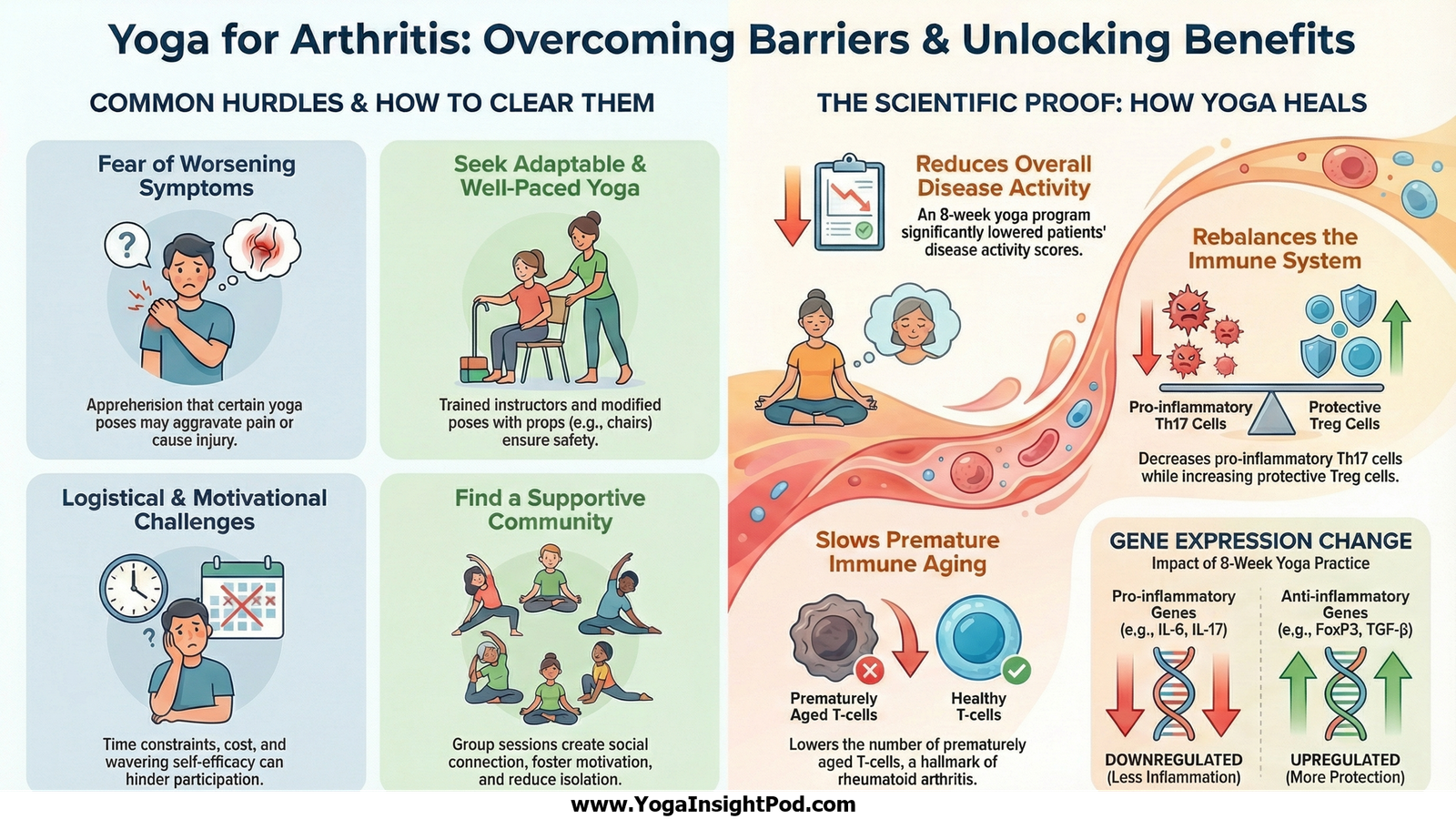
Can yoga do more than improve flexibility for people with arthritis? This episode explores clinical and patient-centered evidence showing how yoga helps restore immune balance, reduce inflammation, and slow immune aging in rheumatoid arthritis while also addressing real-world barriers and facilitators to sustainable practice. Together, these studies offer an evidence-based look at how yoga works biologically and how it can be meaningfully integrated into daily life as a complementary therapy for arthritis.
Yoga is often described as a mind body practice, but the two arthritis papers show just how deeply it can reach from inflamed joints all the way down to immune cells and even gene regulation. In a randomized trial of people with active rheumatoid arthritis on standard medication, an eight week yoga program not only reduced clinical disease activity scores, but also shifted the immune system towards balance: pro inflammatory Th17 cells and “aged” T cell subsets fell, while protective Treg cells rose, alongside lower IL 6 and IL 17, higher IL 10 and TGF β, and favorable changes in DNA methylation and other epigenetic markers. Put simply, yoga here acted like an immune “reset,” slowing immunological ageing and dampening the inflammatory storm that drives joint damage.
The second paper steps back from biology to listen to the voices of people living with arthritis, synthesizing qualitative studies on why they do or do not practice yoga. Many came to yoga with fear that unfamiliar postures might worsen pain or trigger flares, and practical barriers such as transport, cost, scheduling and unsuitable classes could easily derail participation. Yet when sessions were well designed adapted poses, props, clear pacing, and teachers who understood arthritis participants described less pain and stiffness, better mobility and energy, and a growing confidence in their own bodies, often feeling more in control of their condition and, at times, less reliant on pain medication.
Across both papers, a shared narrative emerges: yoga is not a cure, nor a replacement for disease-modifying anti-rheumatic drugs or other standard care, but a powerful adjunct that can work on several levels at once. Biologically, it appears to quiet inflammatory pathways and support immune homeostasis; psychologically, it offers tools for coping, motivation and a renewed sense of normality; socially, it provides a supportive space where people do not feel alone with their arthritis. The research also makes clear that success depends on accessibility and fit programs need to be safe, flexible, culturally sensitive and guided by trained teachers who can tailor practice around painful or damaged joints. When those pieces are in place, yoga for arthritis becomes less about “doing exercise” and more about reshaping the relationship between mind, immune system and aching joints in a way that modern guidelines now cautiously endorse and many patients find genuinely life enhancing.