What makes a yoga program effective for blood pressure management? A systematic review of 34 randomized trials by Gamze Nalbant and colleagues from University of Nottingham, A JBI Centre of Excellence suggests that asana, pranayama, meditation and relaxation, practiced regularly as a balanced program, may be an important combination.
Many studies ask whether yoga can help with blood pressure. This systematic review asked a more practical question: What did the effective yoga programs actually look like?
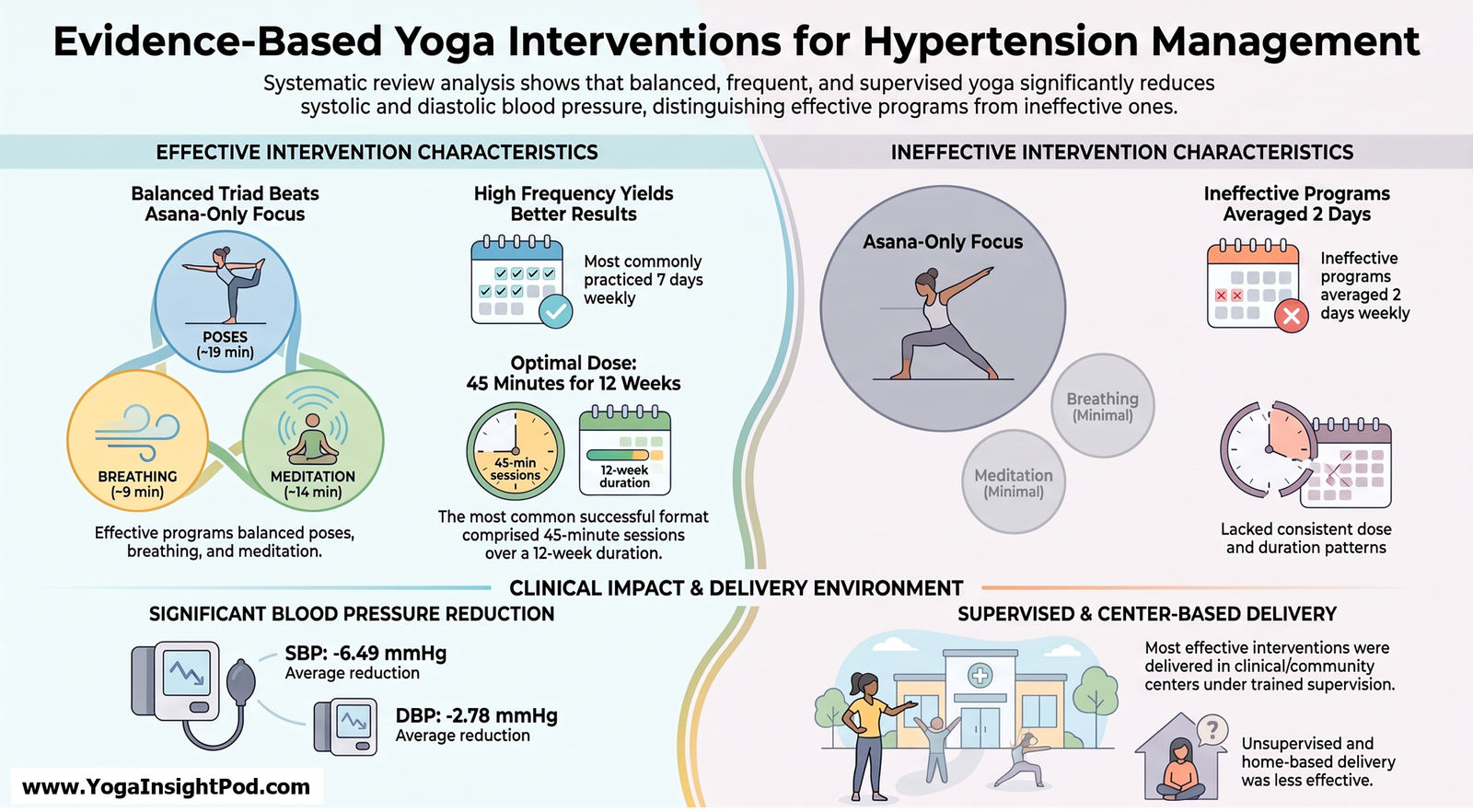
Gamze Nalbant and colleagues reviewed 34 randomized controlled trials evaluating 38 yoga interventions. Overall, yoga interventions were associated with reductions in systolic and diastolic blood pressure compared with control interventions, although the authors emphasized that the included studies were generally of low methodological quality and highly heterogeneous.
A particularly interesting finding involved the composition of yoga practice. Of the 20 interventions considered effective for systolic blood pressure, diastolic blood pressure, or either outcome, 13 incorporated all three major components: asana, pranayama, and dhyana/relaxation. Effective programs generally distributed practice more evenly across these components, while ineffective programs tended to devote substantially more time to asana. The most frequently reported practices in effective interventions were Bhujangasana (Cobra Pose), Anuloma-Viloma/Nadi Shodhana (Alternate Nostril Breathing), and Shavasana (Corpse Pose/deep relaxation). Regularity also stood out. Among effective programs, the most common pattern was 45-minute sessions, seven days per week, for 12 weeks, although programs varied considerably.
The message is not that there is one proven yoga prescription. Rather, this review suggests that yoga may be most useful when treated as a multicomponent practice combining movement, breath regulation, meditation, relaxation, and regular practice.