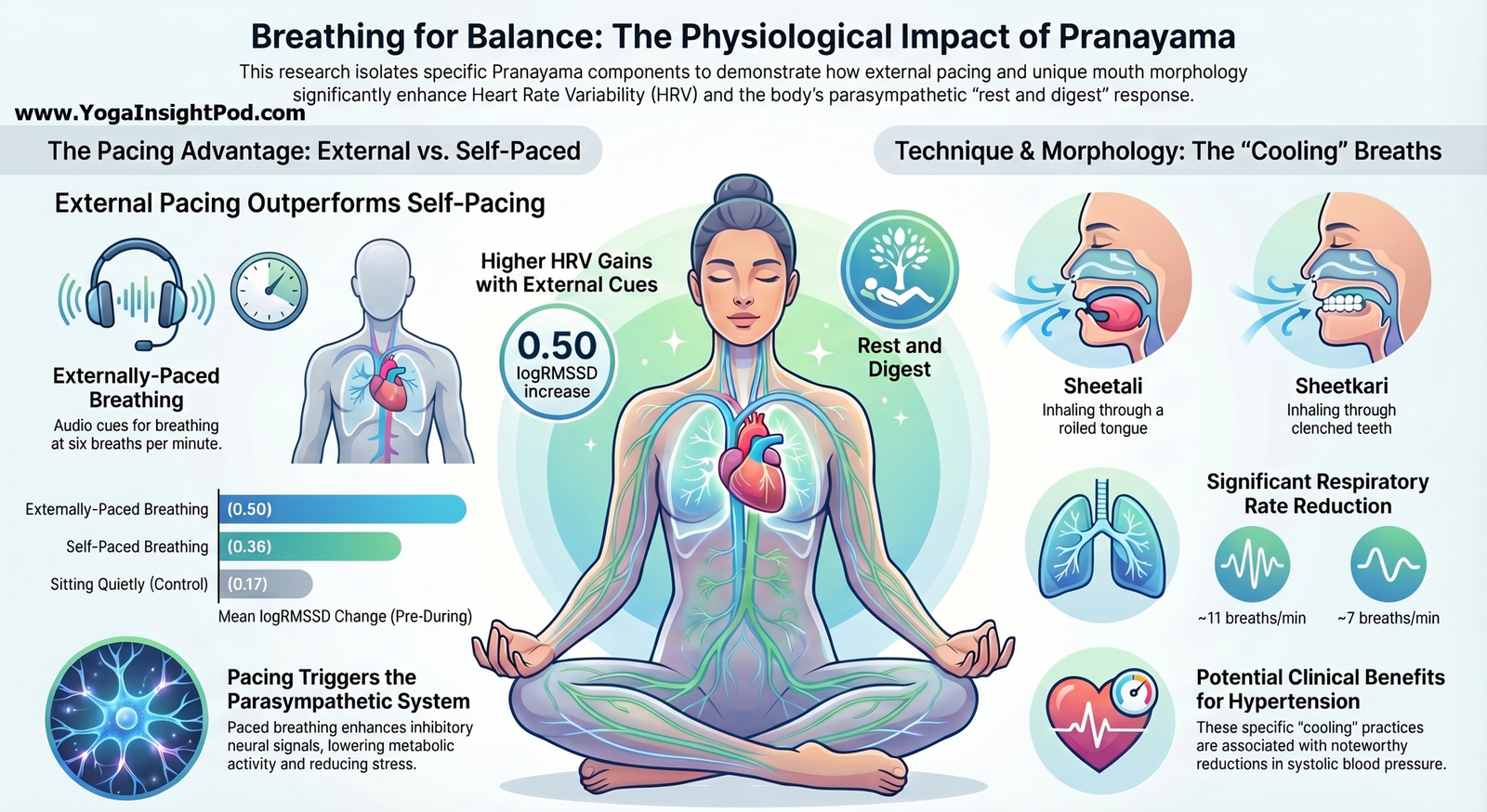
A randomized crossover trial in healthy adults s by Ryan Bradley and team at the Institute National University of Natural Medicine, Portland, OR shows that slow, externally paced breathing whether simple deep breathing or Sheetali/Sheetkari pranayama produces the largest increases in RMSSD, a key heart-rate variability marker of parasympathetic activity. Mouth shaped “cooling” breaths may add small extra benefits, but slow pacing itself appears to be the dominant driver of autonomic change.
A 2021 randomized crossover trial in healthy adults has taken a uniquely granular look at pranayama, asking a simple but important question: which specific components of yogic breathing actually drive changes in heart rate variability (HRV), a key marker of parasympathetic (“rest and digest”) tone and cardiovascular resilience.
Forty-six adults were randomized to complete five separate lab sessions in different orders: sitting quietly; self paced deep breathing; externally paced deep breathing at six breaths per minute; self paced Sheetali/Sheetkari (“cooling”) pranayama; and externally paced Sheetali/Sheetkari. HRV was assessed using RMSSD, a time domain index closely linked to vagal activity at slow respiratory rates.
Across all conditions, RMSSD rose significantly from pre to during practice, with log RMSSD increases of about 0.2-0.5, indicating a robust parasympathetic shift even in this healthy sample. The largest gains occurred with externally paced slow breathing (both standard deep breathing and Sheetali/Sheetkari) compared with simply sitting quietly, and paced breathing produced greater HRV increases than self paced breathing overall. When respiration rate was controlled for, there was a trend toward slightly larger RMSSD increases with Sheetali/Sheetkari compared to generic deep breathing, suggesting that mouth shape and oral airflow may add a small additional effect, though this difference did not reach conventional statistical significance in this pilot.
The authors conclude that slow, externally paced breathing at around six breaths per minute is a powerful driver of acute HRV enhancement, regardless of whether one uses classic “cooling” pranayama or simple diaphragmatic breathing. For clinicians and practitioners, the message is practical: structured slow-breathing protocols especially when guided or paced can reliably nudge the autonomic nervous system toward a calmer, more regulated state, and traditional pranayama variants like Sheetali/Sheetkari may offer incremental refinements worth exploring in larger studies.